Do you prefer to listen?
Here’s the audio version:
If you are a midlife woman living with one or more pets, you may have asked yourself this question: Can dogs detect hormonal changes in menopause?
Maybe you’ve noticed that your dog doesn’t behave exactly the same way around you anymore.
They stay closer.
They watch you differently.
They remain by your side even when you are not actively seeking them.
This is not an isolated moment.
And it is not only about affection.
During menopause, your body goes through a series of transformations that extend beyond what you consciously perceive. Your internal chemistry shifts. Your temperature fluctuates. Subtle details change in ways that may go unnoticed… except for those who are biologically equipped to detect them.
And a dog’s sense of smell is exactly that: a system designed to perceive what remains invisible to us.
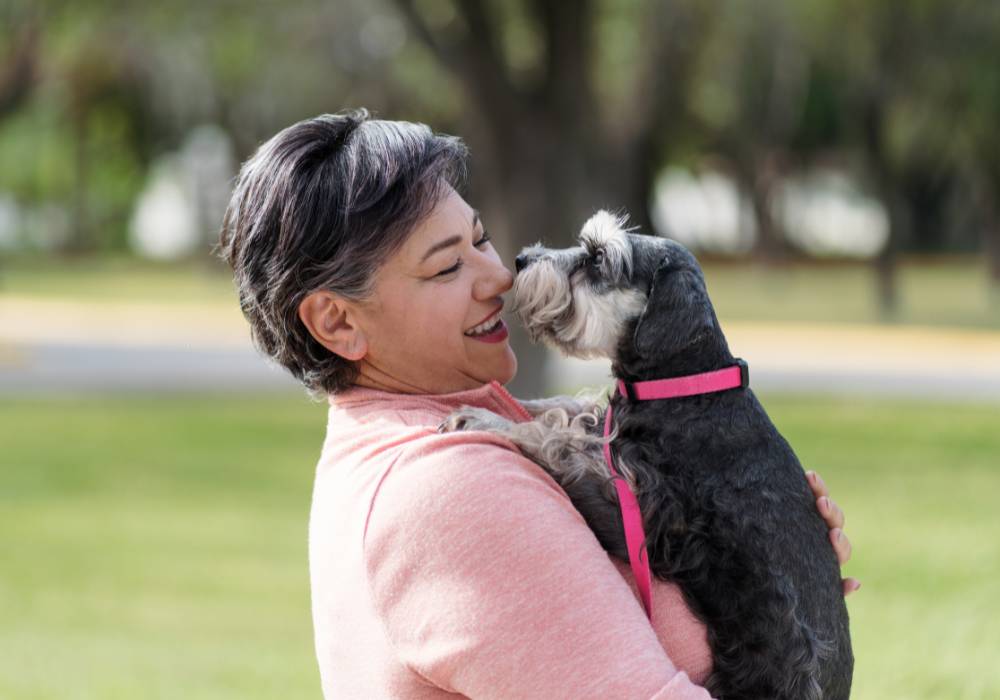
Can dogs detect hormonal changes in menopause?
The short answer is: yes, it is possible.
Dogs have between 200 and 300 million olfactory receptors, compared to around five million in humans. This allows them to detect extremely subtle chemical changes.
And hormones are, at their core, chemical signals.
During menopause, levels of estrogen, progesterone, and other substances fluctuate. These changes can affect:
- body odor
- sweating patterns
- skin chemistry and temperature
All of this creates signals that may go completely unnoticed by you, but not by your dog.
What science actually suggests
Research has shown that dogs can detect biological changes in the human body through scent.
For example, trained dogs have been able to identify hypoglycemic episodes. Other studies suggest that dogs can detect certain types of cancer by recognizing specific chemical compounds.
There is currently no direct research focused on menopause. However, the underlying mechanism is well established: when body chemistry changes, scent changes too.
From that perspective, the question: can dogs detect hormonal changes in menopause, becomes much more grounded in biology than it might seem at first.

Menopause, body odor, and invisible signals
During menopause, many women experience:
- hot flashes
- night sweats
- changes in body odor
- shifts in skin microbiota
These are not just symptoms.
They are also signals.
Your body is constantly communicating what is happening internally, even when you are not consciously aware of it.
Your dog, however, may be.
This doesn’t mean your dog understands menopause. But it can register that something about you is different.
Why your dog may seem more attentive
This is where science meets everyday experience.
Many women describe similar changes in their dog’s behavior during menopause:
- staying closer than usual
- seeking more physical contact
- becoming more alert or protective
- reacting to emotional shifts
There are two main explanations for this.
1. Physical cues
Changes in scent, temperature, and sweat composition.
2. Emotional cues
Dogs are highly sensitive to:
- tone of voice
- posture
- energy levels
- micro-expressions
They don’t need to understand what you are going through.
They simply respond to what they perceive.
Emotional regulation: the other side of the bond
Menopause is not only a physical transition. It often comes with emotional changes such as:
- increased sensitivity
- irritability
- anxiety
- difficulty managing stress
In this context, your dog’s presence can become something more than companionship.
Interaction with animals has been associated with:
- reduced cortisol levels
- increased oxytocin
This means the relationship is not one-sided.
Your dog may be responding to changes in you… but also helping you regulate them.
If you are interested in understanding this connection more deeply, some books on canine behavior and human-animal relationships offer fascinating insights into how dogs perceive and respond to the people they live with.
This isn’t magic. It’s biology and connection
It’s easy to interpret these experiences in exaggerated ways.
“My dog knows exactly what’s happening to me.”
“My dog understands my hormones.”
There’s no need to go that far.
What’s happening is more subtle—and more interesting.
Your dog:
- detects chemical changes
- notices behavioral shifts
- responds to emotional signals
All within the context of a bond.

When the bond becomes deeper
During menopause, many women notice something unexpected: their relationship with their dog changes.
It becomes:
- more intentional
- more emotional
- more meaningful
This doesn’t happen only because your dog perceives changes.
It also happens because you are changing.
Menopause often brings:
- greater introspection
- a need for calm
- less tolerance for noise
- a search for more authentic connections
And animals naturally fit into that space.
They don’t demand. They don’t judge. They don’t compare. They stay.
Many women also find that simple activities such as scent games, enrichment exercises, or more intentional daily walks become meaningful opportunities for calm, connection, and shared wellbeing.
A different kind of companionship
Maybe the question is not only: can dogs detect hormonal changes in menopause.
Maybe the question is:
What are you starting to notice now that you didn’t see before?
Your relationship with your dog can become:
- a space of calm
- a form of emotional regulation
- a quiet, steady presence
And in a stage of life where so much is shifting, that matters.
When understanding changes the experience
Knowing that your dog may be perceiving changes in you doesn’t need to create concern.
If anything, it can bring clarity.
It may help explain why the bond feels different.
Closer.
More present.
More meaningful.
Your dog may not understand menopause.
But it can sense that something in you is shifting.
And instead of moving away, it stays.
Sometimes, that is exactly what we need to move through a period of change:
a presence that doesn’t question, doesn’t judge… and doesn’t leave.
If you are ready to take control and take your first step toward a more conscious and active state of wellbeing, don’t wait any longer. Download our free guide, 5 Keys to Wellbeing in Menopause, and discover simple and effective strategies that will allow you to start feeling better today. The journey toward your new stage begins with information and action.
Affiliate Disclosure: Some resources mentioned in this article may contain affiliate links. If you choose to purchase through them, MenoPawse may earn a small commission at no additional cost to you. We only recommend resources that we believe may provide genuine value to our readers. For more information, please see our Affiliate Disclosure page.
Written by the MenoPawse Editorial Team and medically reviewed by Dr. Nestor Claveria Centurion.
The information in this article is strictly for educational purposes and does not replace the consultation, diagnosis, or care of a licensed healthcare professional. Always consult your doctor before making any health-related decisions. [See Terms and Conditions of Use]