Do you prefer to listen?
Here’s the audio version:
There is an idea many women have heard —sometimes explicitly, sometimes in more subtle ways—: that sexual desire in menopause disappears.
Not suddenly.
Not necessarily as a direct statement.
But rather as a quiet expectation.
As if desire had an expiration date.
As if the body, by changing, also left that part of life behind.
And yet, the real experience of many women is far more complex.
Sexual desire in menopause does not necessarily disappear.
But it can change.
And understanding that change —without fear, without judgment, without myths— can completely reshape how you move through this stage.

Sexual desire in menopause: what happens in the body
During perimenopause and menopause, estrogen and progesterone levels gradually decline.
These hormonal changes can influence different aspects of sexuality:
- vaginal lubrication
- sensitivity
- sexual response
- frequency of desire
Clinical research has shown that hormonal changes during menopause can affect sexual function, particularly in relation to vaginal dryness and comfort during intimacy.
Estrogen also plays a role in the vascularization and elasticity of genital tissues, which can alter the physical experience of sexual activity.
It is important to say this clearly:
Yes, there are real physical changes.
But those changes do not automatically mean a loss of desire.
When the change is not only hormonal
Sexual desire in menopause is not determined by hormones alone.
It is also influenced by:
- emotional state
- relationship with your own body
- quality of the relationship with your partner
- stress levels
- self-perception
Psychological studies suggest that emotional wellbeing and body image play a significant role in female sexuality during midlife.
This means desire is not an automatic response.
It is a complex experience where body and mind are deeply connected.
The cultural myth: “you shouldn’t feel desire anymore”
Beyond biology, there is a cultural narrative that strongly shapes sexual desire in menopause.
A narrative that suggests:
- desire belongs to youth
- the mature body is less desirable
- female sexuality has a time limit
It is not always spoken out loud.
But it is transmitted.
Through media.
Through silence.
Through the absence of representation.
And over time, that message can begin to shape how you see yourself.
When desire changes its form
Many women do not experience a disappearance of desire, but a transformation.
Sexual desire in menopause can become:
- less spontaneous
- more contextual
- more connected to emotional intimacy
- less impulsive, but more conscious
This is not a loss.
It is a shift in pattern.
The role of your relationship with yourself
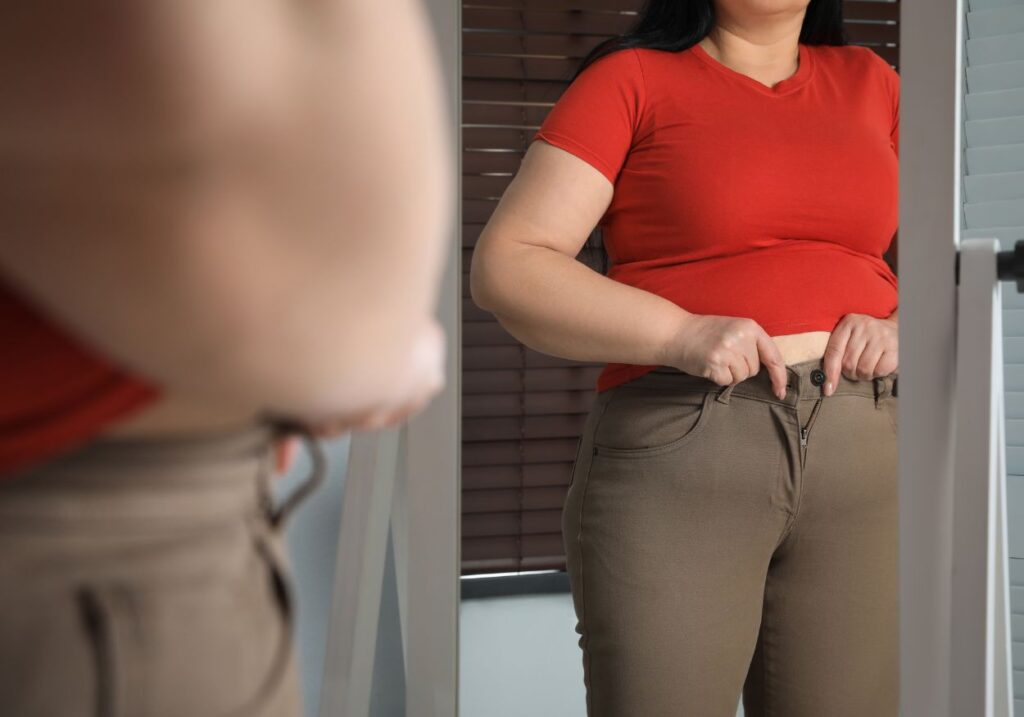
There is something that is rarely said out loud when discussing sexual desire in menopause: the fear of no longer being desirable.
Not only to others.
But to yourself.
During this stage, the body changes:
- skin
- weight
- shape
- energy
But what often goes deeper is not the physical change itself.
It is the way you look at it.
Many women begin to wonder, even if they do not say it explicitly:
“Am I still attractive?”
“Do I still fit into what is considered desirable?”
“Is my body still valid in that language?”
When there is no clear answer, something more subtle appears:
- a withdrawal
- discomfort with one’s own image
- a growing distance from the body
Not necessarily because the body has lost value, but because for years it was seen through a very specific standard: young, firm, unchanged.
When that standard no longer fits, it can feel like being left out.
And that feeling directly affects desire.
Not because desire disappears, but because it becomes harder to inhabit your body with ease.
Because it feels harder to be seen.
Because, deep down, it feels harder to feel valid in that space.
It is important to say this honestly: very often, it is not desire that fades. It is the relationship with yourself that becomes more demanding.
Reconnecting with desire, in this context, is not only physical.
It involves reshaping the way you see yourself.
A gaze less defined by expectations.
And more connected to who you are now.
Stress, fatigue and mental load
Sexual desire in menopause also coexists with everyday realities:
- accumulated responsibilities
- family changes
- work demands
- ongoing mental load
When the nervous system is in a constant state of alert, it does not prioritize desire.
It prioritizes survival.
When to seek support
If the discomfort is significant —pain, persistent aversion, emotional distress— it may be important to consult a healthcare professional.
Not as a last resort, but as another form of care.
The World Health Organization recognizes sexual health as a fundamental part of overall wellbeing, including during life stages such as menopause. This means what you are experiencing is not minor or secondary — it is part of your quality of life.
Seeking medical or psychological support does not invalidate your personal process.
It can support it, expand it, and offer practical tools to navigate this stage with greater clarity and ease.
Sexual desire in menopause: a more honest perspective
Sexual desire in menopause is not linear.
Perhaps the most important thing is not to return to what it was before, but to allow desire to find its current form.
Without comparison.
Without inherited expectations.
If you are ready to take control and take your first step toward a more conscious and active state of wellbeing, don’t wait any longer. Download our free guide, 5 Keys to Wellbeing in Menopause, and discover simple and effective strategies that will allow you to start feeling better today. The journey toward your new stage begins with information and action.
Written by the MenoPawse Editorial Team and medically reviewed by Dr. Nestor Claveria Centurion.
The information in this article is strictly for educational purposes and does not replace the consultation, diagnosis, or care of a licensed healthcare professional. Always consult your doctor before making any health-related decisions. [See Terms and Conditions of Use]