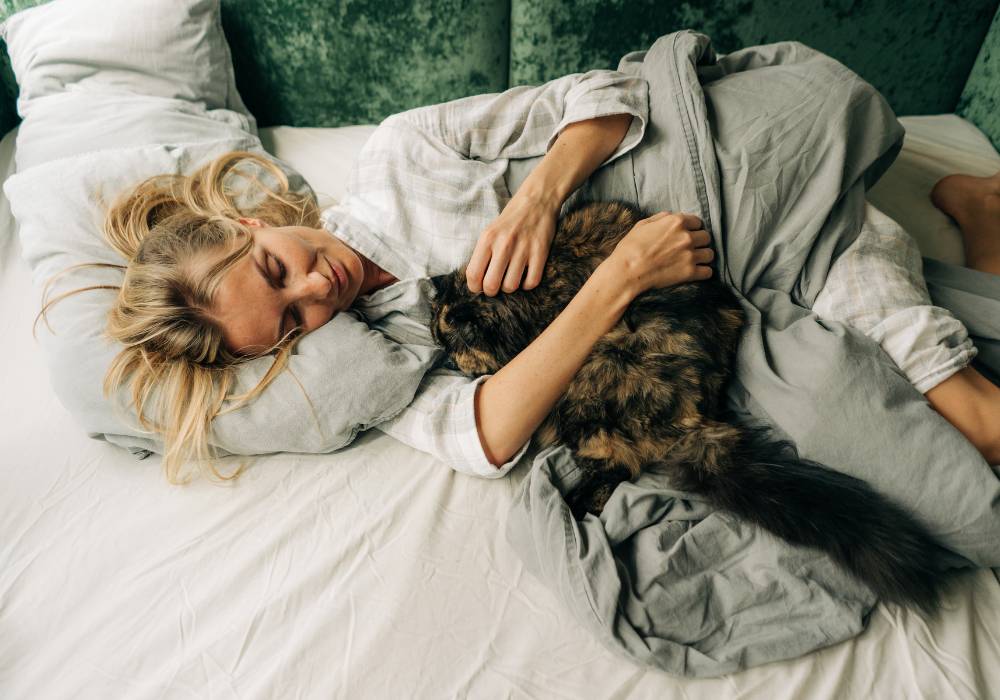
It’s eleven at night. You get into bed hoping this time will be different. And your cat, with that particular precision cats have, appears, circles once, and settles in beside you.
You stroke it almost without thinking. And something, very slowly, begins to give.
If you have menopause insomnia and you live with a cat, you may have noticed that those minutes before turning off the light have a quality to them. A different texture. A way of slowing down what couldn’t slow down during the day.
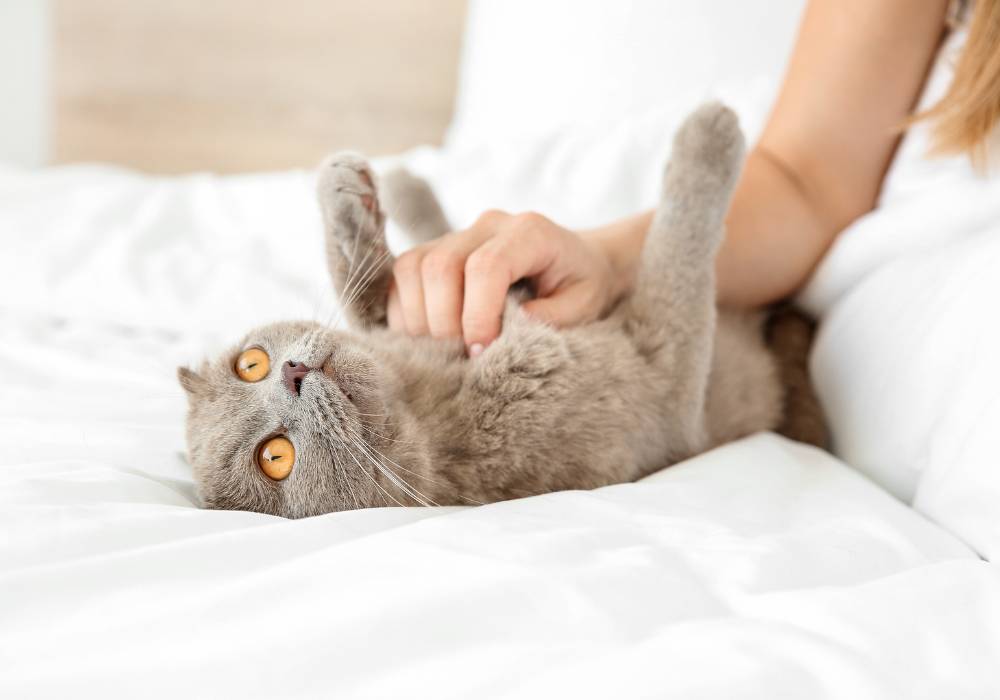
Stroking your cat before sleep isn’t just a gesture of affection. From a biological standpoint, it’s a stimulus that can directly influence the mechanisms that regulate stress and rest.
Why Menopause Insomnia Has a Hormonal Foundation
Before talking about your four-legged companion, it’s worth briefly recalling what’s happening in your body at night.
During menopause, the decline of estrogen and progesterone disrupts several systems connected to sleep. Melatonin production — the hormone that regulates the sleep-wake cycle — decreases. Progesterone, which has a naturally sedating effect on the nervous system, stops acting as a buffer. And night sweats, when they appear, fragment rest at precisely the moments the body needs it most.
The result is a pattern many women know well: difficulty falling asleep, waking in the middle of the night, or the sensation of having slept for hours without having actually rested.
Cortisol adds another layer. If the day has been long, demanding, or emotionally intense, levels of this hormone can remain elevated into the night, keeping the nervous system in a state of alert that makes the transition to sleep harder.
And this is exactly where stroking your cat before sleep can have a real effect.
What Happens in Your Body When You Stroke Your Cat
Gentle physical contact activates the parasympathetic nervous system: the body’s rest-and-recovery mode. It is the physiological opposite of the alert state that cortisol sustains.
A study conducted with cat owners in Japan documented that free interaction with their cat — without forcing the contact — reduced emotional arousal in owners and produced measurable changes in heart rate variability, a direct indicator of the balance between the sympathetic and parasympathetic nervous systems.
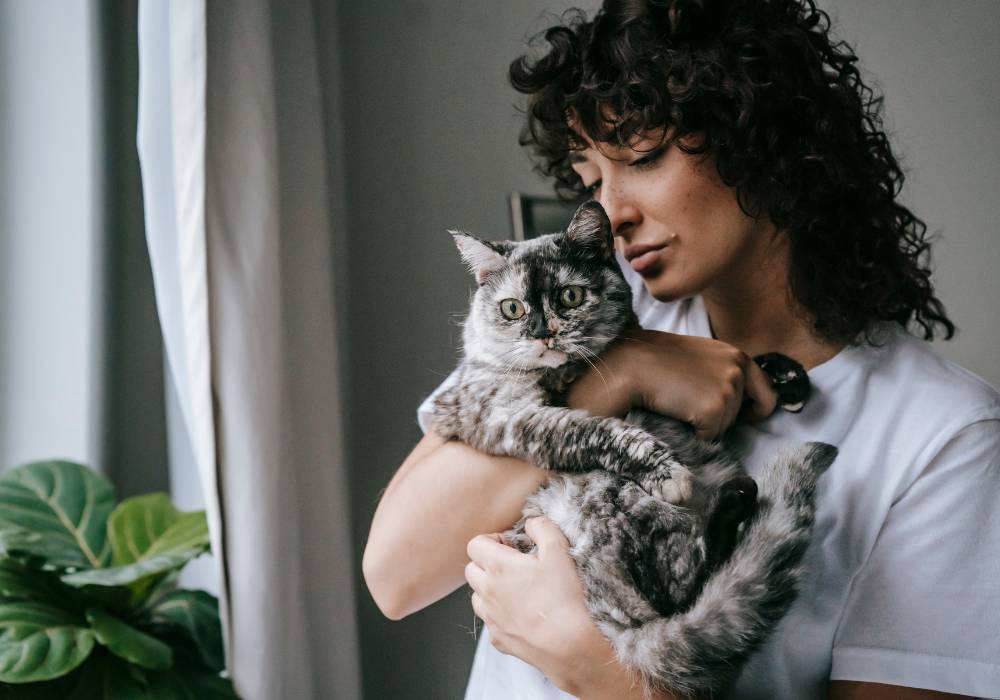
More recently, a 2025 study monitored oxytocin levels in cat owners during 15 minutes of relaxed contact with their cat at home. Results showed that when owners engaged in relaxed petting, cuddling, or cradling of their cats, the owners’ oxytocin tended to rise — and so did the cats’ — as long as the interaction was not forced on the animal. The more time the cat voluntarily stayed close to its person, the greater the hormonal boost for both.
An earlier study found that this oxytocin surge from gentle cat contact helps lower cortisol, which in turn can reduce blood pressure.
Purring as a Calming Frequency
There’s something about a cat’s purr that deserves its own mention.
The acoustic frequencies of purring range between 25 and 150 Hz. Within that range sit frequencies that have been associated in other contexts with relaxing effects on the nervous system and reductions in blood pressure.
This is still a developing area of research, and it’s worth not overstating it. But the experience of many people who live with cats points in a coherent direction: a cat’s purr has something that invites the body to lower its guard.
Stroking your cat before sleep while listening to that sound is a combination of stimuli that, for many women with menopause insomnia, can make the difference between a tense night and a night that starts to yield.
Stroking Your Cat Before Sleep: How to Make It Part of Your Nighttime Routine
A predictable nighttime routine is one of the most evidence-backed tools for improving sleep. The brain learns to associate certain sequences of actions with preparing for rest.
If you live with a cat, you have a natural element to include in that routine.
It doesn’t need to be long or elaborate. Five to ten minutes of calm contact — lights already dimmed, no screens nearby — can be enough to send the nervous system a clear signal: the day is over.
Some ideas for making it part of the ritual:
- Turn off screens and sit somewhere comfortable with your cat before going to bed.
- Stroke slowly and rhythmically, without rushing.
- Pay attention to the texture of the fur, the warmth of its body, its breathing.
Nothing else is required. That moment of presence is itself a form of regulation.
Some women find it helpful to add a layer of consistent background sound to that ritual: a white noise machine can help mask the small disturbances that might otherwise interrupt a light sleeper.
If your cat sleeps with you, the effect can extend through the night. Gentle physical contact with a cat has been shown to be linked to elevated oxytocin in owners, while simultaneously helping suppress the stress hormone cortisol, effects that can support not just falling asleep, but staying asleep.
Of course, this also depends on the particular temperament of your cat, which may not always cooperate with anyone’s rest plans.
What Your Cat Can’t Do (And Why That’s Worth Saying)
Being honest here is part of the respect this conversation deserves.
Stroking your cat before sleep can be a real support for menopause insomnia. But it isn’t a treatment, and it doesn’t replace professional care when the sleep problem is severe or persistent.
If you’ve been sleeping poorly for weeks consistently, if the fatigue is affecting your ability to function during the day, or if the insomnia is accompanied by intense anxiety or significant mood changes, speaking with your doctor remains the most important step.
Your cat can be with you through each difficult night. But you’re the one who has to take the step of asking for help when you need it.
Stroking Your Cat Before Sleep: A Small Form of Real Care
During menopause, sleep can become fragile, elusive, unpredictable. And sometimes, in the middle of everything that can’t be controlled, there is something within reach.
Literally.
Stroking your cat before sleep doesn’t change the biochemistry of menopause. It doesn’t eliminate hot flashes or reset hormone levels. But it can help the nervous system remember how to yield, how to slow down, how to prepare for rest.
And in a stage where the body is asking for more calm than the day tends to offer, that’s already quite a lot.
If you are ready to take control and take your first step toward a more conscious and active state of wellbeing, don’t wait any longer. Download our free guide, 5 Keys to Wellbeing in Menopause, and discover simple and effective strategies that will allow you to start feeling better today. The journey toward your new stage begins with information and action.
Affiliate Disclosure: Some resources mentioned in this article may contain affiliate links. If you choose to purchase through them, MenoPawse may earn a small commission at no additional cost to you. We only recommend resources that we believe may provide genuine value to our readers. For more information, please see our Affiliate Disclosure page.
Written by the MenoPawse Editorial Team and medically reviewed by Dr. Nestor Claveria Centurion.
The information in this article is strictly for educational purposes and does not replace the consultation, diagnosis, or care of a licensed healthcare professional. Always consult your doctor before making any health-related decisions. [See Terms and Conditions of Use]